Selig S1223 Flow on Earth and Mars
An S1223 on Earth and on Mars: A CFD Story
This is a small project from a while back that I've been meaning to revisit, and since I have some free time on my hands, I dug out the reports and set about re-explaining, mostly to myself, the intrinsic details of the wonderful world of CFD. The premise is simple. Take a Selig S1223 aerofoil, fly it through Earth's cosy air, then fly it through the Martian atmosphere, and see what the numbers say about each. ANSYS Fluent did the solving, MATLAB did the plotting.
The motivation isn't hard to state. Humanity has big plans for the red planet, colonies, drones, whatever comes after, and the aerodynamic problem underneath all of it is severe. The Martian atmosphere is about 1% of Earth's density, roughly 600 Pa of surface pressure against our 101,325, with gravity at 3.7 m/s². Flying there is something like trying to swim in a kiddie pool, the medium you need to push against is barely there. Which is exactly why I picked the S1223, a low Reynolds number, high-lift champion, 12.1% thickness at 19.8% chord, 8.1% camber at 49%, full details at airfoiltools. If any section can squeeze lift out of nothing, it's this one, and the "low Re" part of its pedigree matters more than it might first appear, we'll get to why.
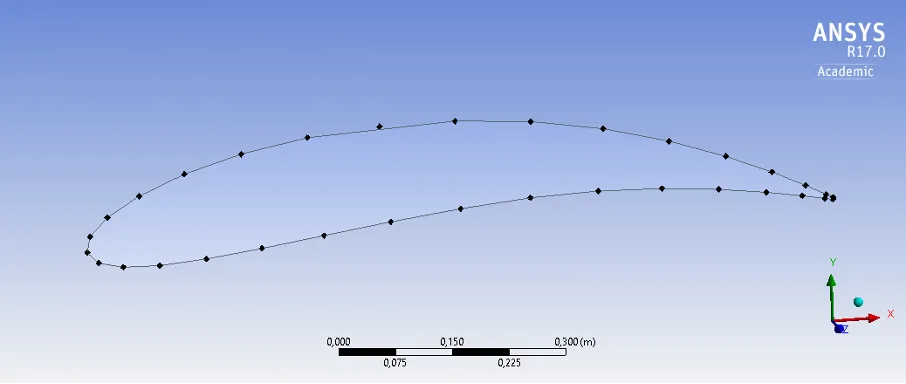
Geometry first. I pulled the S1223's coordinate set, the 2D points that define the section in Cartesian space, imported them into ANSYS Design Modeler, and connected them with splines, nose at (0,0). Around the aerofoil I constructed a domain 10 chord lengths across, with for simplicity, giving a 10 m radius. Why 10? Far enough that the outer boundary doesn't contaminate the flow around the section, and in line with common CFD practice, boundary interference is one of those errors that doesn't announce itself, it just quietly biases your forces. A Boolean subtraction then removed the aerofoil shape from the domain, leaving a hollow wing-shaped cutout for the flow to negotiate.
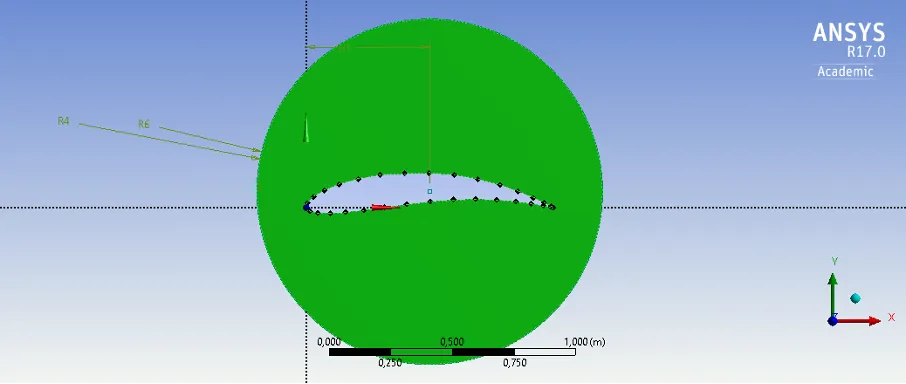
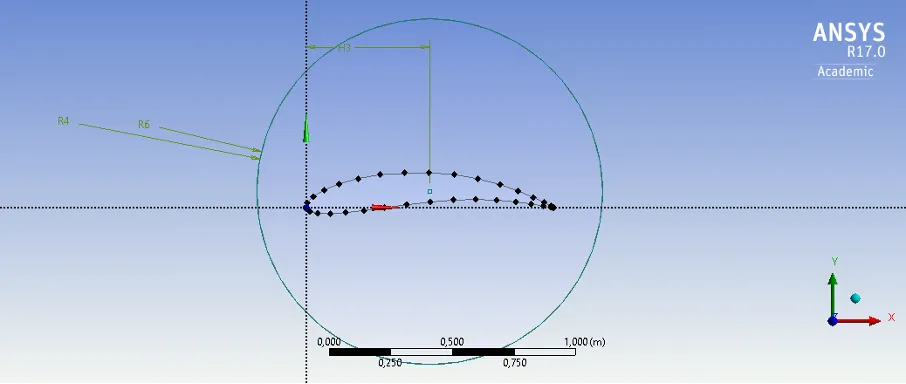
To finish the domain, I added a semicircle upstream at a 5-chord radius to define the inlet, connected it to the outer circle with straight lines, and split the whole thing into two zones, a fluid region and a rotating region held in reserve for the transient cases later. The final geometry is below.
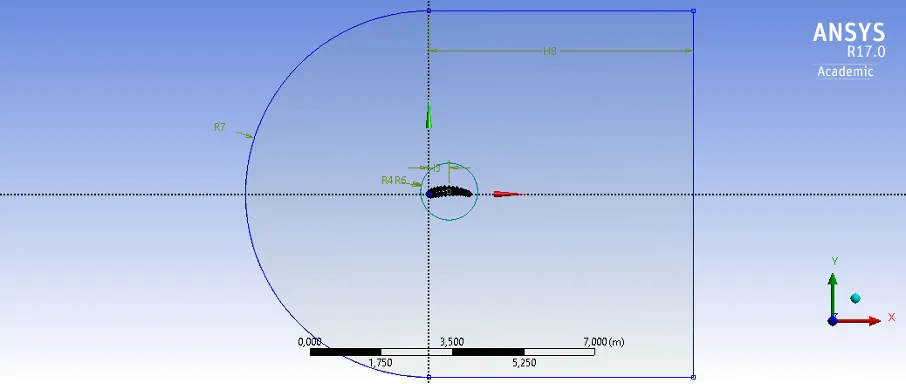
Everything here is 2D. Partly because 3D would have flattened my PC, I simply didn't have the computational power, but the honest defence is better than the resource excuse, 2D captures the core physics of the comparison I'm making, section lift and drag across two atmospheres, and I'm not trying to certify an Airbus.
The mesh deserves more attention than meshing usually gets in write-ups, because the solver is only ever as good as the grid underneath it. I went with triangular elements, 0.01 m around the aerofoil where the gradients live, easing to 0.02 m near the inner circle, and out to a 1.0 m maximum in the far field where nothing interesting happens.
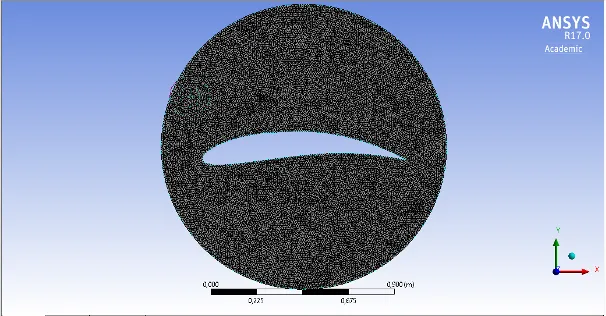
One press of Generate Mesh later:
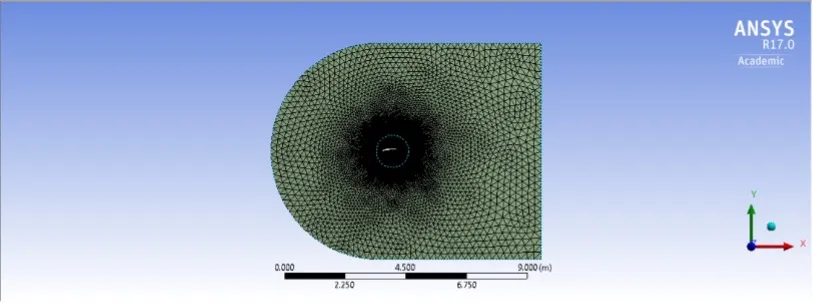
The quality stats came out at an orthogonal quality of 0.97 and a skewness of 0.0356, which is comfortably good for this analysis. And this matters for a reason worth spelling out rather than waving at. The Navier-Stokes equations I'm about to solve are partial differential equations, and discretising PDEs on a garbage grid is an invitation to numerical diffusion at best and outright divergence at worst. The discretisation error scales with for second-order schemes, which is precisely why the grid tightens near the aerofoil, that's where the error budget gets spent. The quality metrics guard the solver's assumptions, orthogonal quality , with the angle between face normals and element edges, and skewness , both of them ways of asking whether each cell is close enough to its ideal shape that the solver's internal approximations hold.
Into Fluent, then, with a transient, pressure-based solver, transient because the rotating cases later demand it. For the momentum equation I picked a second-order upwind scheme, and the justification is the Peclet number, , which sits well above 2 throughout this problem, meaning convection dominates diffusion. Run a first-order scheme in that regime and it smears the solution like a bad watercolour. Second order adds a correction term that keeps the velocity and pressure fields sharp:
where is the transported variable, velocity or pressure, is the cell centre and the face. It's a Taylor expansion at heart, and it keeps the physics crisp.
Pressure-velocity coupling turned into a proper ordeal. I started with SIMPLE and the residuals wobbled. Tried SIMPLEC, then PISO, same story. After some reading I switched to the COUPLED algorithm, which solves pressure and velocity together in a single matrix rather than the staggered predictor-corrector dance, and for transient flows with relatively large time steps, 0.01 s here, it's the right tool. Convergence went silky smooth after the switch, which is its own small lesson, when three segregated algorithms all misbehave the same way, the problem usually isn't the tuning, it's the coupling strategy itself.
Boundary conditions, 10 m/s inlet velocity in the x-direction, zero gauge pressure at the outlet, no-slip walls on the aerofoil. Earth's air at 1.225 kg/m³ and 1.81e-5 Pa·s viscosity, Mars at 0.015 kg/m³ and 1.42e-5 Pa·s. And here's where the real story of this comparison sits, in the Reynolds number, , which with a 1 m chord comes out around 670,000 on Earth and around 10,500 on Mars. That's not the same flow made thinner, that's a different flow. A factor of sixty in Re moves you into a regime that's far more laminar-dominated, with different boundary layer behaviour, different separation tendencies, different everything that matters near the surface, and it's exactly why the S1223's low-Re credentials were the selection criterion rather than a footnote. The Mach number check clears easily, 10 m/s on Mars is about 0.03, so incompressible flow is a fair assumption, and the governing equations are the incompressible Navier-Stokes pair, continuity and momentum
Forces come out of surface integrals over the section, lift and drag , with the angle of attack, pressure, and the shear stress, and the coefficients normalise by dynamic pressure, , .
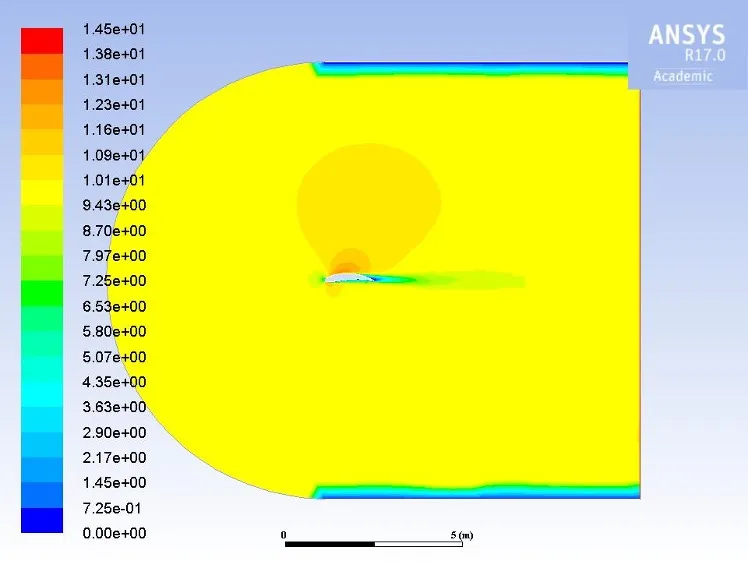
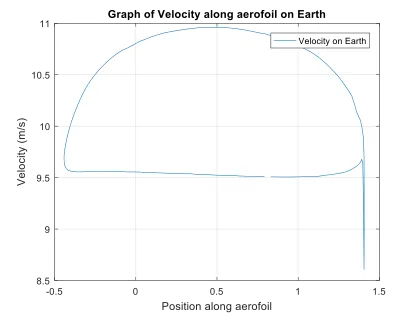
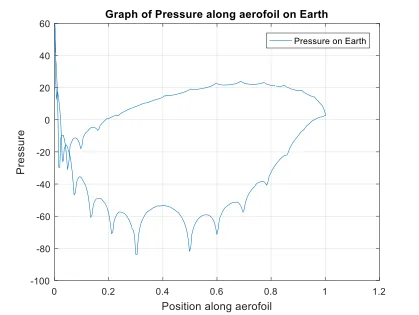
I ran three conditions, zero angle of attack, non-zero angle of attack, and a rotating aerofoil, on both planets. At zero AoA on Earth, the velocity contours peak at 11 m/s over the upper surface, Bernoulli doing what Bernoulli does, faster flow, lower pressure, and the pressure plot dips to -20 Pa gauge on the upper surface, driving 55 N of lift against roughly 5 N of drag, , .
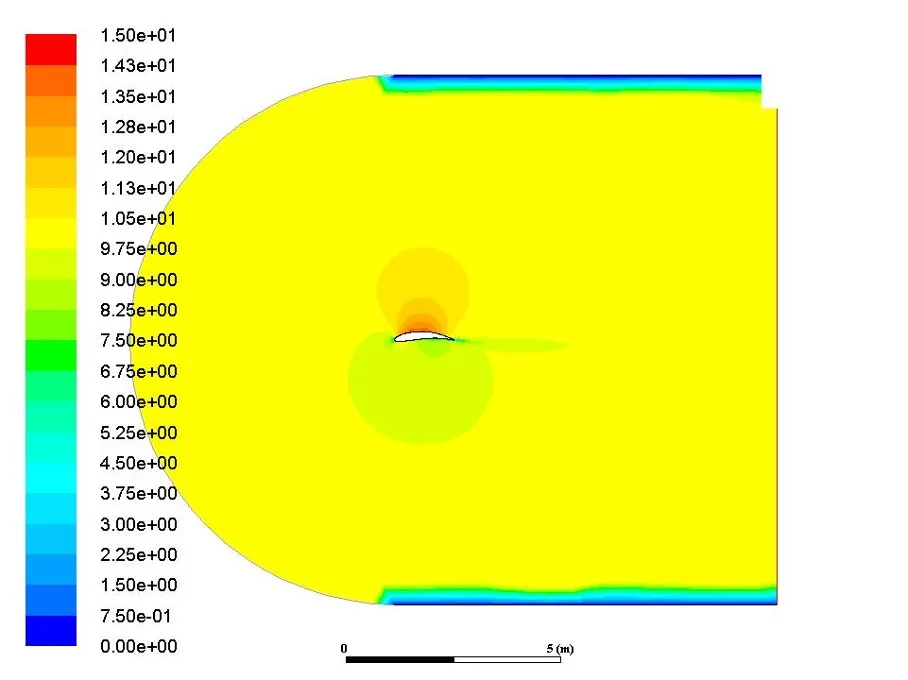
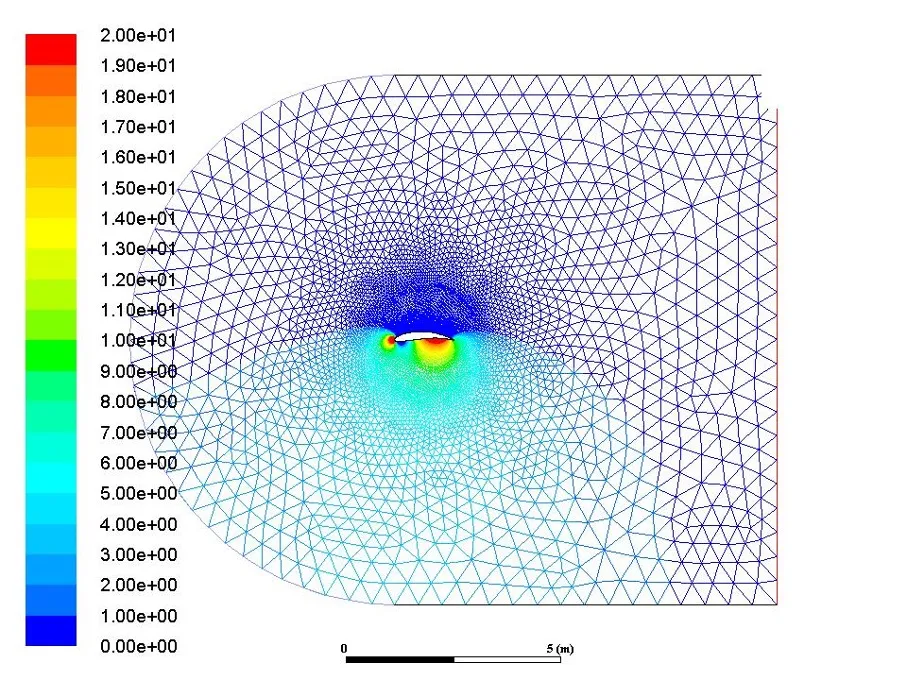
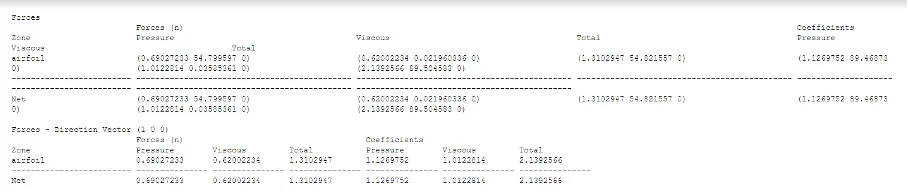
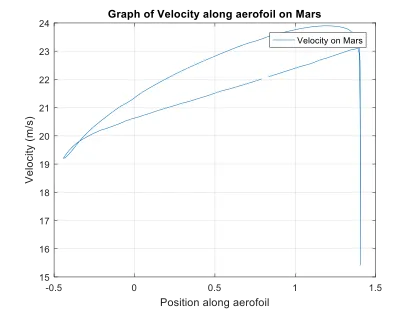
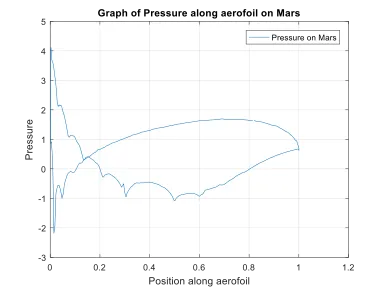
On Mars, the flow accelerates to 24 m/s over the top, the thin air puts up less resistance, but the pressure differential barely reaches 2 Pa and the lift comes out at 1 N, , . The Martian density deficit dominates everything in these frames.
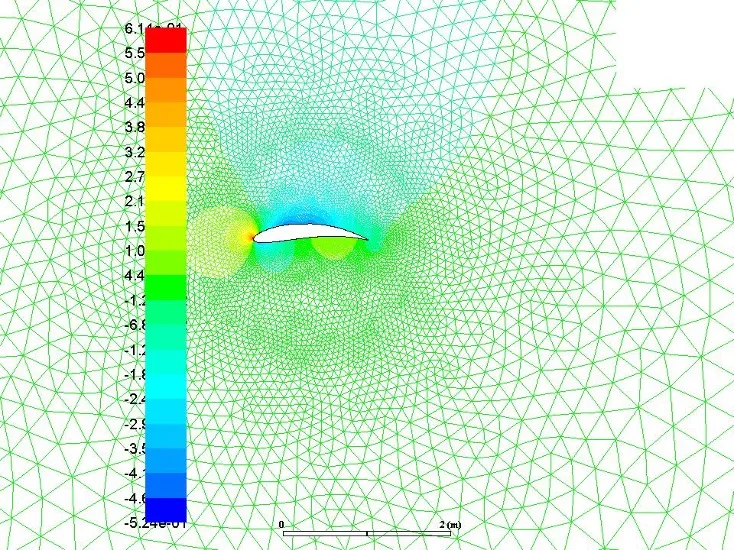
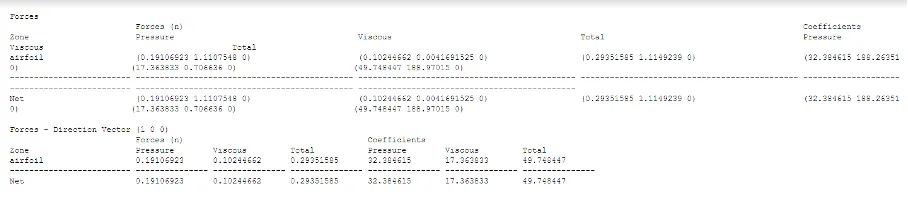
It's worth keeping the two effects separate in your head, because they're doing different damage. Lift scales with , and Martian density is 80 times smaller, so even with the higher local velocities the dimensional lift is fighting a losing battle, that's the first effect, pure scaling. The second effect is the Re regime shift changing the character of the flow itself, which shows up in the coefficient, dropping from ~1.1 to ~0.7 at the same geometry and angle. The gravity discount, a third of Earth's, means you need less lift to fly there, but 1 N against even Martian gravity on any useful vehicle mass won't remotely cut it.
Pitch the section to 5° and Earth responds the way the textbook promises, velocity hits 12 m/s, the pressure gradient steepens, and lift jumps to around 70 N, you can almost feel the wing wanting to leave.
Mars responds too, velocity pushing 25 m/s, pressure creeping to 3 Pa, lift nudging up to 1.5 N. Better, still anaemic. The mechanism is the standard one, , more angle presenting more perpendicular pressure force, and it works on both planets, it just has 80 times less medium to work with on one of them.
For the last case, mostly for the joy of it, I spun the aerofoil at 10 rad/s in a transient simulation. Earth's flow field turns theatrical, vortex shedding, wild eddies trailing downstream, pressure swinging hard with peaks at 50 Pa. Mars sheds vortices too, tamer for lack of density, but the unsteadiness is unmistakably there. Lift oscillates in both cases, averaging around 60 N on Earth and 1.2 N on Mars.
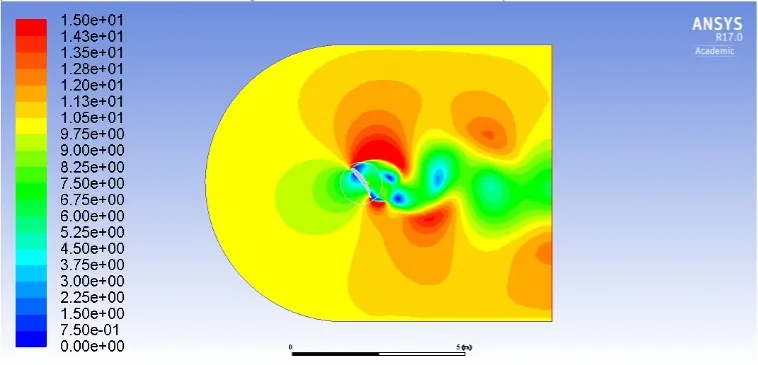
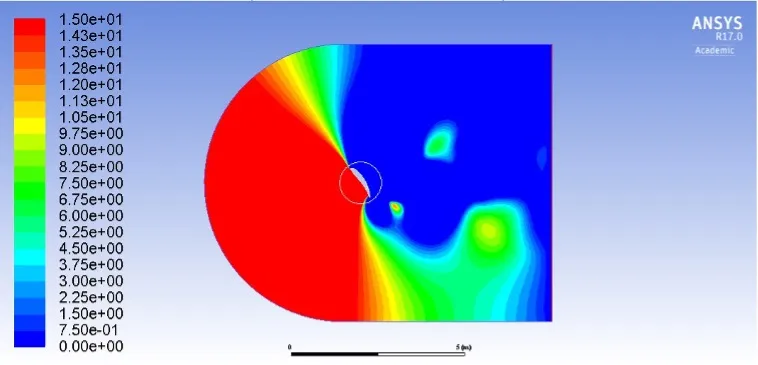
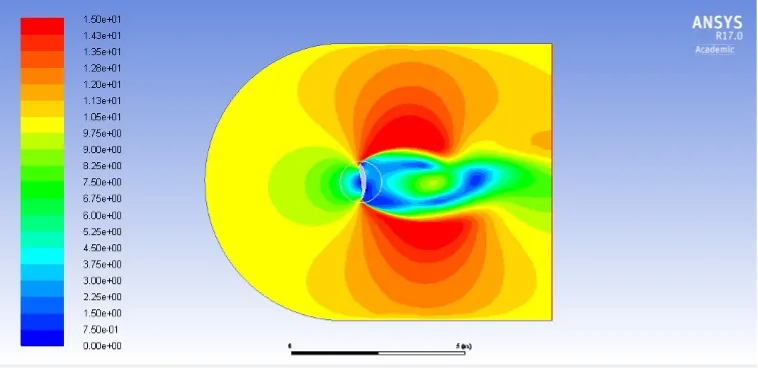
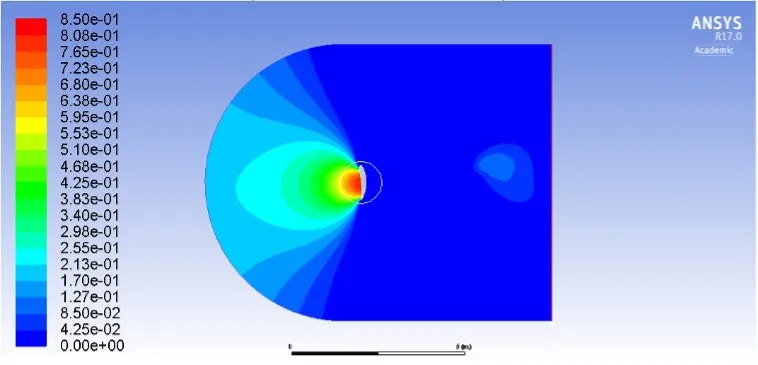
The 1D slice plots tell the same story in compressed form. Earth's pressure trace shows a sharp -20 Pa dip at 20% chord, the peak lift zone, while Mars sits flat, maxing out around 2 Pa, and the velocity plots mirror it, Earth peaking at 11 m/s, Mars at 24. Simple slices, but the density contrast reads off them at a glance.
So what did the exercise actually establish? The S1223 is genuinely good at low-Re lift, which is why it's the right section for this question, but the thin Martian air is a brutal limiter that aerofoil selection alone cannot overcome, 55 N on Earth against 1 N on Mars at identical geometry and airspeed. Closing that gap takes bigger wings, much higher speeds, or active flow control, there's no free path. The rotating case was the genuine surprise of the project, the unsteady aerodynamics were richer than expected on both planets, and unsteady lift mechanisms might be something close to a cheat code for Martian drones, which is presumably part of why rotorcraft got there first in reality. If I redid this, I'd sweep the angle of attack from -10° to 20° for proper polars instead of point samples, refine the mesh near the trailing edge where the vortices are born, and go 3D to catch the spanwise effects a 2D domain structurally cannot see. I also underestimated how much fun transient CFD is. Watching those vortices dance felt like peeking under nature's hood, and I mean that without irony. Flying on Mars will take real ingenuity, oversized wings, aggressive speeds, or some flapping-wing technology that still reads as science fiction, and maybe next time I'll try simulating a Martian rotorcraft, which will be a considerably bigger ordeal than this one.
The key parameters, side by side:
| Parameter | Earth | Mars |
|---|---|---|
| Density (kg/m³) | 1.225 | 0.015 |
| Pressure (Pa) | 101,325 | 600 |
| Viscosity (Pa·s) | 1.81e-5 | 1.42e-5 |
| Reynolds Number | ~670,000 | ~10,500 |
| Lift at Zero AoA (N) | 55 | 1 |
| at Zero AoA | ~1.1 | ~0.7 |
And the solver configuration, with the reasoning attached:
| Setting | Choice | Reason |
|---|---|---|
| Solver Type | Transient, Pressure-Based | Captures rotating cases, better convergence |
| Momentum Scheme | Second-Order Upwind | Reduces numerical diffusion, Pe > 2 |
| Pressure-Velocity Coupling | COUPLED | Handles large time steps, stable residuals |
| Time Step | 0.01 s | Balances accuracy and compute time |